Just when I thought the last module was long I was COMPLETELY wrong this one has done has done a number on me ! So, during this lesson I gained information on how basically “America” came about and what it took to get up to where we are today. So let’s begin on what was the main cause of the Revolutionary War, the main cause of this war was INDEPENDENCE! That was the whole objective of this war. The people who had freed themselves from the British went to the New lands and gotten a taste of struggle and freedom with very little strings attached. Once this had started it was the beginning of the “Melting Pot” this is when people had gotten mixed up with the Natives and they were owning slaves and living in a so called diverse world to them. Also during the 17th century when there was a king that when Parliaments and laws were enforced. This is were the idea of Bill of rights came from in 1628 and this is were the idea of some our written documents came from and since then it has been a continuous thing for the United States. Other scenarios played a part in this era too such as the Great awakening were it was a religious war going on within the colonies and also the Seven year war as well. I feel that all variables of this era are extremely important because it has developed how we are today so each part has played a tremendous role within our history, but the most important part about the whole thing is the Revolutionary war. I believe this because what if we would’ve lost that war? Would things be the way they are now?Also I feel like the Natives and the Slaves played a major part within this history era simply because if it wasn’t for them the colonies wouldn’t have been here. And that is something that we should think about. This module has taught me how we have developed as a country and what shaped and molded us as a whole we have had a lot of blood sweat and tears. And quite frankly we still have a lot of that going on today I learned about us breaking free from Britain and having some new alliances. It just information that has expanded my education on how America has really started. That is what this module has taught me!
Sunday, November 17, 2019
Reflection,Module 7: Revolution & Independence
Just when I thought the last module was long I was COMPLETELY wrong this one has done has done a number on me ! So, during this lesson I gained information on how basically “America” came about and what it took to get up to where we are today. So let’s begin on what was the main cause of the Revolutionary War, the main cause of this war was INDEPENDENCE! That was the whole objective of this war. The people who had freed themselves from the British went to the New lands and gotten a taste of struggle and freedom with very little strings attached. Once this had started it was the beginning of the “Melting Pot” this is when people had gotten mixed up with the Natives and they were owning slaves and living in a so called diverse world to them. Also during the 17th century when there was a king that when Parliaments and laws were enforced. This is were the idea of Bill of rights came from in 1628 and this is were the idea of some our written documents came from and since then it has been a continuous thing for the United States. Other scenarios played a part in this era too such as the Great awakening were it was a religious war going on within the colonies and also the Seven year war as well. I feel that all variables of this era are extremely important because it has developed how we are today so each part has played a tremendous role within our history, but the most important part about the whole thing is the Revolutionary war. I believe this because what if we would’ve lost that war? Would things be the way they are now?Also I feel like the Natives and the Slaves played a major part within this history era simply because if it wasn’t for them the colonies wouldn’t have been here. And that is something that we should think about. This module has taught me how we have developed as a country and what shaped and molded us as a whole we have had a lot of blood sweat and tears. And quite frankly we still have a lot of that going on today I learned about us breaking free from Britain and having some new alliances. It just information that has expanded my education on how America has really started. That is what this module has taught me!

Monday, October 28, 2019
Reflection, Module 6: European Colonization II
 Whoo!! This module has been a lot to process read and think about. It is so much information and things to learn about makes my brain hurt a little. During this module, I learned about pretty much the colonization of the East Coast. Also how and why the pilgrims came about and the types of mediators between the pilgrims and Indians and last but not least the Pequot war. Also, the reason why Thanksgiving is celebrated. It all began with the Puritans it began in the 16th century these are the people who really rebelled the British, these people had their own way of living they rebelled numerous ways they didn't want their lifestyles to be tied to England at all. They wanted to have their own religion and other things dealing with their daily lives. Squanto who was a Patuxet Indian and helped the Pilgrims and the Indians get along this was during the 17th century. A lot did happen for it to Squanto to end up to that point he was captured and was supposed to be sent to Spain, but luckily he escaped and came back to where he came from. This is how he began his journey as a mediator and a leader. When Squanto finished this brought the Pilgrims and Indians together this is what created Thanksgiving, a few states such as Florida, Texas, Maine,& Virginia had already started this so-called tradition. This was before the pilgrims arrived on the Mayflower which was a huge ship that voyagers came off from England. In Plymouth Fall of 1621 is when this holiday became official, now Thanksgiving is something that happens all across the United States of America. Now getting in the Pequot war the English feel that the Indians were out to kill and destroy what the English thought was theirs so it led to war and this leads to history with this module it was a lot learned.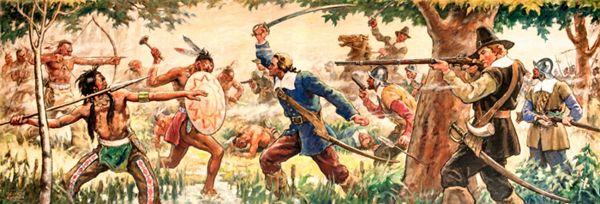
Legends of America, www.legendsofamerica.com/pequot-war/.
“Squanto.” Biography.com, A&E Networks Television, 23 June 2019, www.biography.com/political-figure/squanto.
Saturday, October 5, 2019
Reflection, Module 5: European Colonization I


Gama, Vasco da, et al. “European Colonization in North America: Spanish, French, Dutch, & British Colonies (Unit I, Segment 1 of 5) - Ppt Video Online Download.” SlidePlayer, “European
Exploration of the New World.” Spain, bullisglobalhistoryspain.weebly.com/.slideplayer.com/slide/4761954/.
Wednesday, September 18, 2019
Reflection, Module 4:Transatlantic Slave Trade
 Module 4 is very eye opening simply because I learned a slew of things about how this African Slave Trade went into play. This module has showed a lot of facts that no one even thought about, such as the Portuguese starting the whole thing, every since I've been in school I thought the Europeans were the main ones to control the entire Slave Trade. But unfortunately during my whole school career has been a tall tale. Finding out that approx. 20 million slaves were traded during that time was outstanding to find out. Learning that in the different African Communities they didn't mind selling one another which made the African Slave trade industry grow was very saddening to find out, simply because treating people like animals were sickening. Over the fact that a simple opinion such as a change of religion. Also reading from the weekly assignment (Slavery and Spanish Colonization) finding out that the Portuguese trying to make Natives or "Indians" slaves at first wasn't working so they began to look for a different source, and that source turned out to be West Africa. Along with slavery came a great amount of Agriculture growing sugar was the main crop that had to began to boom during the 16th century. Spain and Portugal were the ones to began this whole trade situation, Sugar had became one of the highest product demanded during that time.
Columbus's Voyages in 1492 had opened up a whole new world for the Atlantic Slave Trade. Allowing countries such as Spain, Portugal, France, Dutch, and England to establish colonies with in the Americas. The Caribbeans and Brazil was the place were the mass majorities of slaves went, which was an a astonishing fact to find out, because I always thought that the United States had the most slaves only to find out that the US had a small percentage of 4 -5%. Brazil received the most percentage of slaves they had over 40% , any British or Caribbean had a percentage of 25% and any other Spanish country located in South America only received a small 7%. During this entire module I learned a lot of new information that needs to be taught every where textbooks should stop twisting these stories and reveal the truth. I am excited to continue to learn more about this era.
Rice, Claude. “Age of Exploration 1400s to 1700s - Ppt Video Online Download.” SlidePlayer, 8 Oct. 2017, slideplayer.com/slide/4653563/.
“Grade 7 - Term 2: The Transatlantic Slave Trade.” South African History Online, www.sahistory.org.za/article/grade-7-term-2-transatlantic-slave-trade.

Wednesday, September 4, 2019
Reflection, Module 3: European Exploration

https://brewminate.com/early-globalization-the-atlantic-world-1492-1650/
http://scihi.org/henry-navigator-discoveries/

MAMcIntosh. “Early Globalization: The Atlantic World, 1492–1650.” We're Never Far from Where We Were, 10 Feb. 2018, brewminate.com/early-globalization-the-atlantic-world-1492-1650/.
Monday, August 26, 2019
Reflection, Module 2

Before Christopher Columbus discovered the "The Americas" the Native Americans or Indians were living in their own systematic ways, this was comfortable enough for them. When Christopher Columbus arrived in the Virgin land around the 15th or 16th century, he didn't understand their way of living and thinking. This also was scary to him only because there was a civilization of people, it was so many Natives that it was astonishing. It was plenty of evidence that these Native Americans were living in their own colonies and communities.

Places such as Folsom, NM had evidence that was discovered in 1926 the evidence of life was a spear sticking in a bison's ribs. This piece of the fossil had dated to about 2,000 years old and this was a great reveal for signs of life. Another city that discovered evidence was Clovis, NM this is where they found Clovis points and those Clovis points were found across the Americas, and they also outdated the fossils from Folsom. These Clovis points dated to be 13,500 years old, these were later found a few years after the Folsom fossils.
Theses Indians came by the millions and there were a variety of cultures, languages, and ways of life. I know we haven't gotten this far but a question I will have is; What happened to these millions of Indians and how did they disappear so quickly? This was a significant part of the module because there wouldn't
be History without any evidence of life and productivity.
Thursday, August 15, 2019
Testing New Blog
Hi, Everyone
This is my first time blogging, I am just doing a test run... Let's see if I can get hang of this Blogging thing! I wonder if this is going to be difficult?
This is my first time blogging, I am just doing a test run... Let's see if I can get hang of this Blogging thing! I wonder if this is going to be difficult?
Subscribe to:
Posts (Atom)